Why This Product Exists
Most mental health apps are built around productivity: streaks, goals, daily check-ins that feel like homework. They work well when you're already motivated — but on the days you need support most, they add pressure instead of relief.
Still Space takes a different approach. At its center is Still — an AI companion you can talk to by text or voice that listens without judgment and meets you where you are, instead of asking you to relax on command. Around it: a quick mood check-in, 159+ practices matched to your current energy, calming soundscapes, and a journal that quietly surfaces patterns from your feelings, sleep, and activity. Evidence-based techniques — behavioral activation, mindfulness, expressive writing — wrapped in a warm, pressure-free interface. Inspired by research, designed with care.
The problem space
41%
Of employees experience significant daily stress — mental health support is no longer optional
Gallup, 2024
80%
Of workers are at risk of professional burnout, with emotional exhaustion as the leading symptom
Gallup, 2025
81%
Of mental health app users worry about data sharing — most apps fail basic privacy standards
Mozilla Foundation, 2023
4.7×
Return on investment for mental health programs — every dollar spent returns $4.70 in productivity and reduced costs
WHO / Deloitte, 2024
Target audience
- Anyone looking to build a sustainable daily self-care practice without pressure
- People experiencing stress, emotional fatigue, or burnout — at work or in life
- Teams and organizations seeking accessible mental health support for employees
Competitor Analysis
Before designing Still Space, I mapped the mental health app landscape to understand where existing products fall short — especially in making evidence-based techniques accessible without friction.
|
Still Space |
Headspace |
Calm |
Daylio |
Bearable |
| Core approach |
Evidence-based self-care: behavioral activation, mindfulness & reflection |
Guided meditation & mindfulness |
Sleep stories, meditation & soundscapes |
Micro-journaling & mood tracking |
Symptom & mood tracking for chronic illness |
| AI companion (text & voice) |
✓ Core feature |
✗ |
✗ |
✗ |
✗ |
| Adapts to emotional state |
✓ Core focus |
✗ |
✗ |
✗ |
Partial |
| Adaptive to energy level |
✓ 4 levels |
✗ |
✗ |
✗ |
✗ |
| Streak-free / no guilt mechanics |
✓ |
✗ Streaks & badges |
Minimal |
✗ Streaks & badges |
✓ |
| Crisis resources built-in |
✓ Hotlines in 6 countries |
✗ Redirects to 911 |
✗ |
✗ |
✗ |
| Actionable micro-tasks |
✓ 159+ practices by energy level |
Meditation only |
Meditation only |
✗ Logging only |
✗ Tracking only |
| Privacy-first (no data sharing) |
✓ |
✗ Shares with ad networks |
✗ Shares with marketers |
✓ Local storage |
✓ |
| Ukrainian & Russian |
✓ |
✗ |
✗ |
✓ |
✗ |
| Pricing |
Free + optional premium |
$69.99/yr |
$79.99/yr |
$35.99/yr |
$34.99/yr |
Key insight: Most mental health apps focus on a single technique — meditation, or journaling, or tracking. None of them combine an AI companion with behavioral activation, mindfulness, and reflection in one adaptive, private space. Still Space fills this gap: talk to Still by text or voice, get 159+ energy-matched practices, calming soundscapes, expressive writing (Pennebaker method), and a journal with AI-surfaced patterns — all in a warm, pressure-free experience.
UX Tone & Voice
Every word in Still Space is a design decision. The voice is warm, unhurried, and accepting — as if a caring friend is sitting next to you.
Role: not a therapist, not a coach — a gentle companion who stays with you.
Forbidden patterns
- "Start your day right"
- "Pull yourself together"
- "You can do it!"
- "Try harder"
- "Stay positive"
- "Don't give up"
Permitted patterns
- "If it works — great"
- "If not — that's okay"
- "Let's just try"
- "No rush"
- "Just being is already huge work"
- "You have the right to feel what you feel"
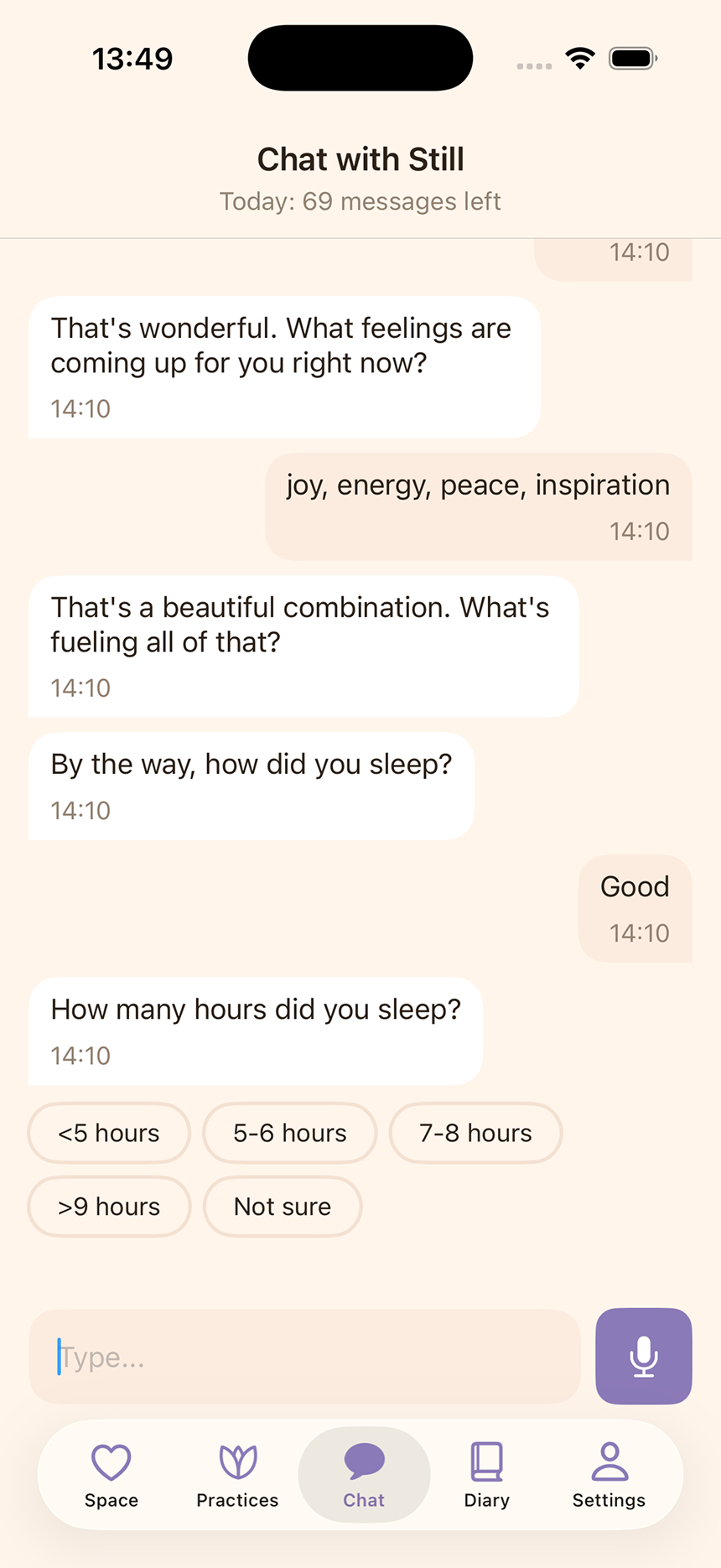
These rules aren't just for static copy — they define how Still, the AI companion, talks too. A typical exchange stays curious and light: "What feelings are coming up for you right now?" … "That's a beautiful combination. What's fueling all of that?" — and then, gently, "By the way, how did you sleep?" The companion reflects rather than advises, and never reaches for the forbidden patterns above.
Key Screens
Space — your daily check-in
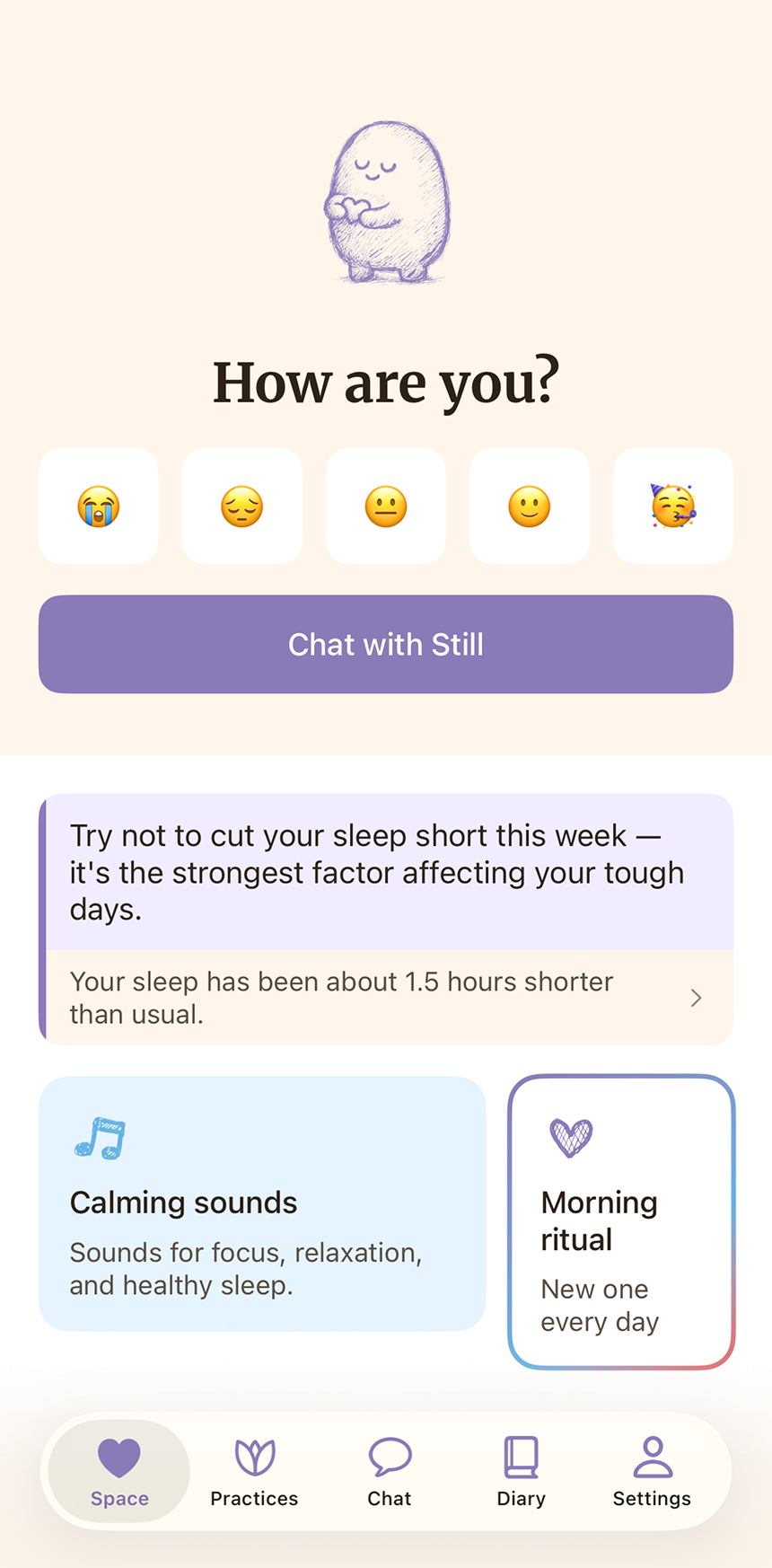
The home tab opens with the companion character and a one-tap mood check-in — a five-level scale, no overthinking. From here you can start a conversation with Still, see a gentle AI insight drawn from your recent data ("Try not to cut your sleep short this week — it's the strongest factor affecting your tough days"), and reach calming soundscapes or the day's morning ritual. A five-tab bar — Space, Practices, Chat, Diary, Settings — keeps everything one tap away.
Chat with Still — the AI companion
The heart of the app: a judgment-free companion you can talk to by text or voice. Still listens, reflects your feelings back, asks gentle follow-ups, and weaves in context — your sleep, your mood, what you've been through — without ever sounding clinical. Quick-reply chips lower the effort of answering, and a visible daily message count keeps usage transparent. Designing Still meant defining a persona and conversational behavior, not just an interface: what it may say, what it must never say, and how it stays warm when someone is at their lowest.
Short practices
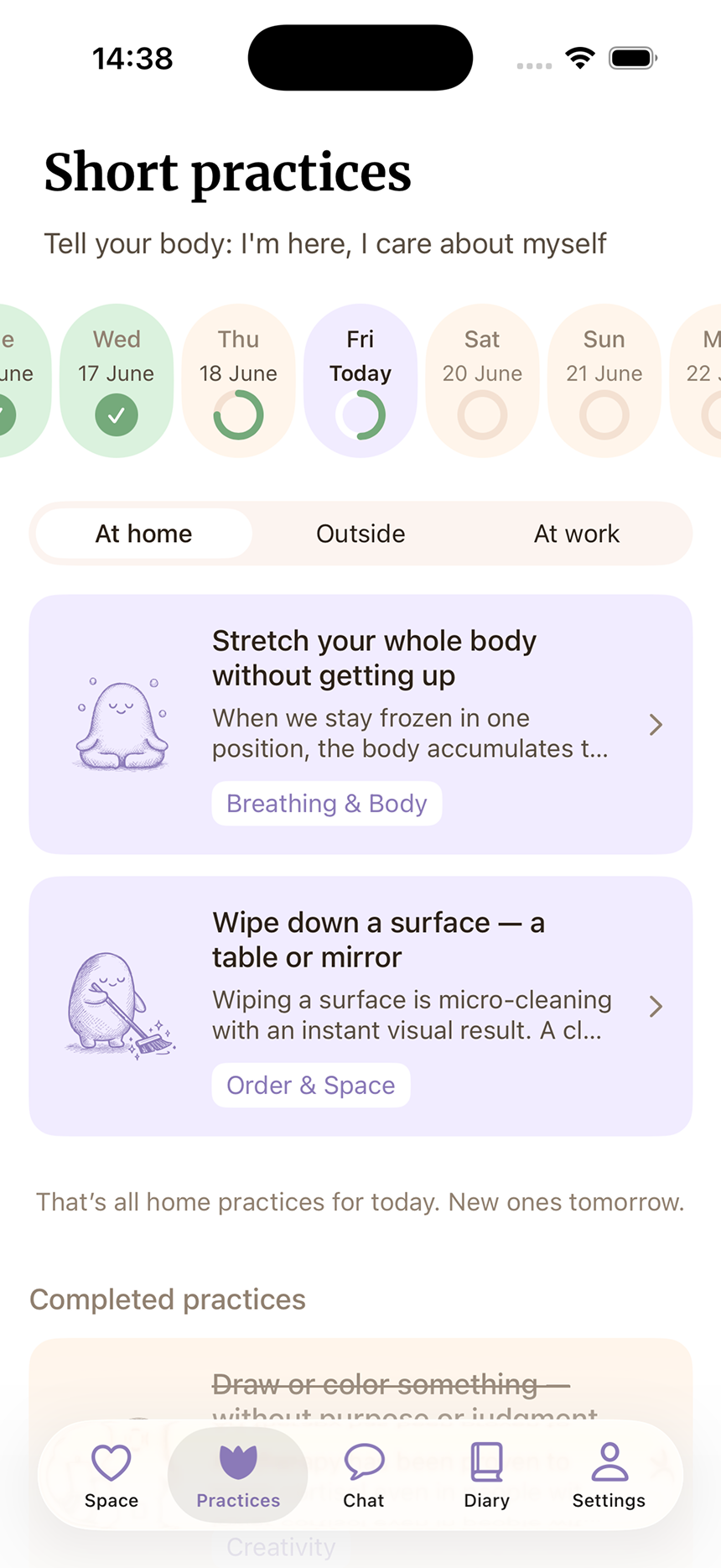
159+ micro-actions grounded in behavioral activation — the evidence-based approach of using small, manageable activities to lift mood (effect size: Hedges' g = 0.85). Practices are matched to your energy and filterable by context — At home, Outside, or At work — and each day's set is paced so it never feels like a backlog ("That's all home practices for today. New ones tomorrow."). A soft daily progress ring marks what you've done without becoming a streak to defend; completed practices drop into your journal as self-care wins.
Diary — your journal
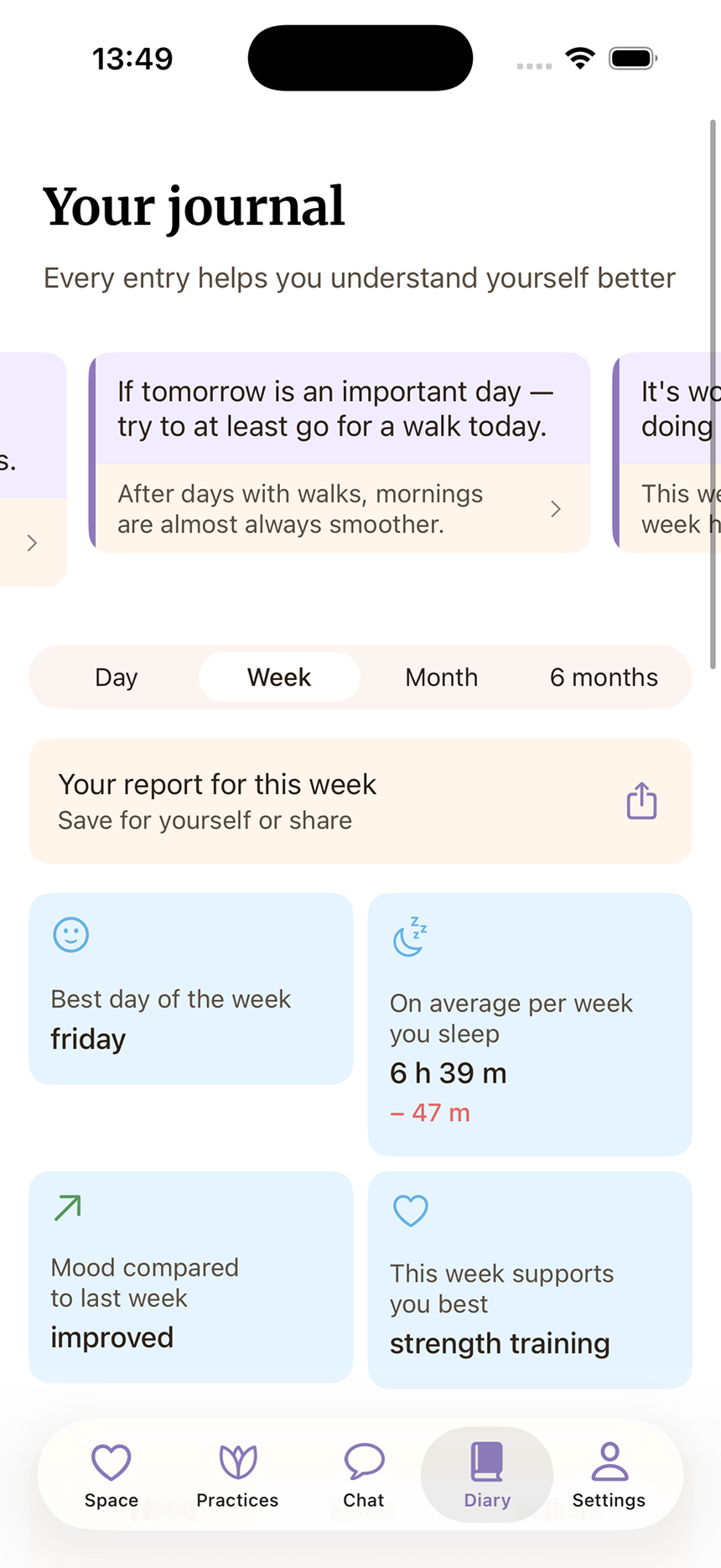
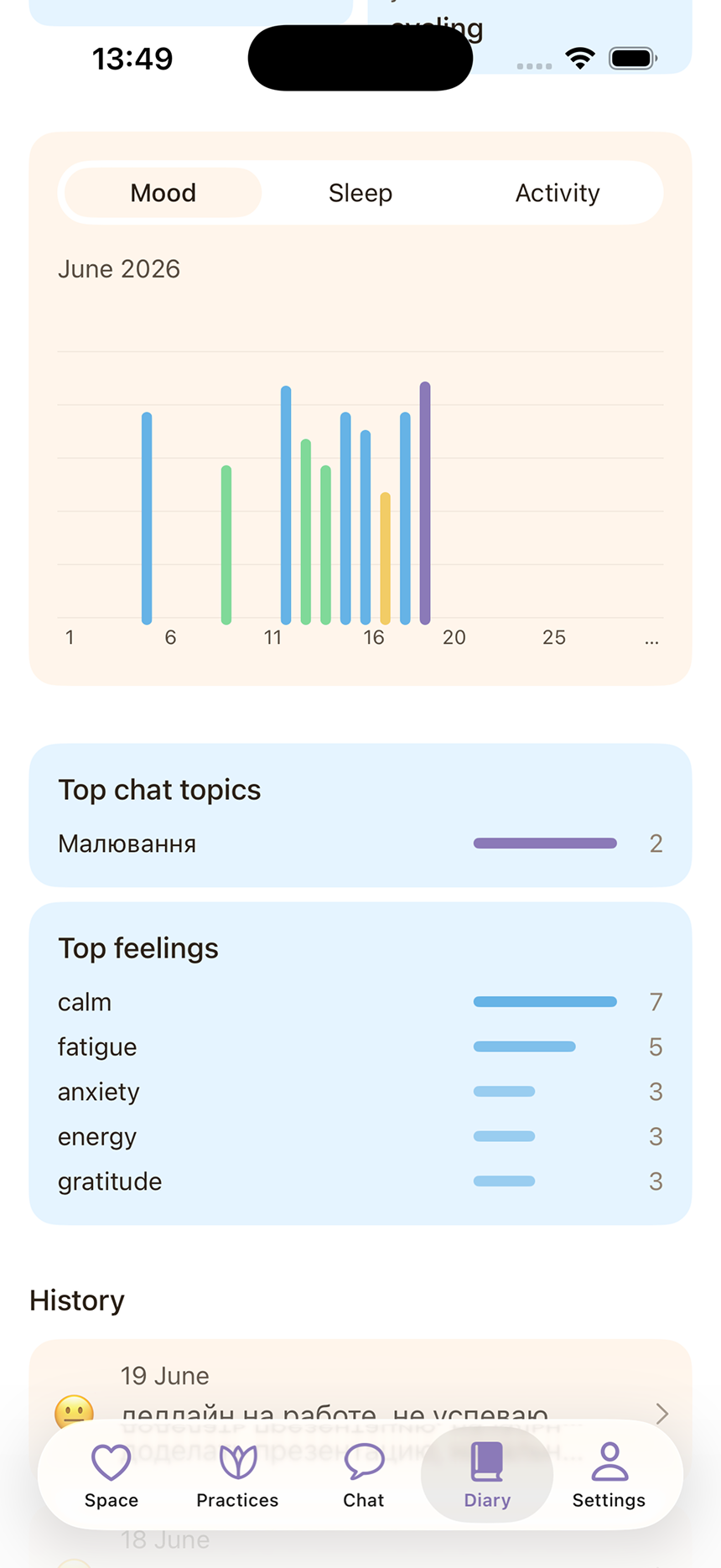
The diary turns scattered check-ins into a picture you can actually read. Zoom out to Day, Week, Month, or 6 months; Mood, Sleep, and Activity each get their own view, with HealthKit quietly supplying sleep and activity data. The weekly report distills everything into plain-language cards you can save or share — best day, average sleep and how it changed, mood compared to last week, and what supported you most ("This week supports you best: strength training"). Below, Top chat topics and Top feelings (calm, fatigue, anxiety, energy, gratitude...) summarize what's been on your mind — surfaced from your conversations and entries, never framed as a score to chase.
Building with AI
Still Space is AI-native in two senses: it was designed and developed with Claude (Anthropic) as a creative and engineering partner — and it ships an AI companion, Still, at its core. The first let one person take a complete product from idea to the App Store in 7 days; the second is the product itself.
What AI enabled in the build
- Rapid prototyping: From concept sketches to working SwiftUI code in hours, not weeks
- Content creation at scale: 159+ localized practices, daily rituals, reflection questions, and thoughts of the day across 3 languages — each carefully crafted for tone and grounded in evidence-based approaches
- Design system as code: Color tokens, typography, spacing, character illustrations — defined once in design, immediately reflected in production code
- Iteration speed: Testing ideas in real code instead of static mockups — seeing how animations feel, how the companion responds, how flows connect
Designing the companion
- Persona, not a chatbot: Still is a gentle presence — curious, unhurried, never a therapist or a coach. Its voice follows the same do/don't rules as the rest of the app
- Safety by design: What it must never say, how it responds to distress, and an always-available path to crisis resources
- Grounded in your context: Reflecting sleep, mood, and recent entries back to the user so the conversation feels seen, not generic
What stayed human
- Product vision: The "why" — understanding what makes self-care sustainable, not just another app to abandon after a week
- Emotional design: Tone of voice, the companion character's personality, the feeling of warmth — these require empathy AI can support but not originate
- Ethical decisions: Privacy-first architecture, evidence-based content curation, no gamification of wellbeing
- Curation: AI generates options; a designer decides what truly serves the user